
There is a scene that plays out in enterprises every single day. A sales representative finishes a customer call, opens their laptop, and begins a familiar ritual: update the CRM, cross-reference the ERP for inventory, check the email thread for context, log the call notes, trigger the follow-up task, and send the proposal. Each of these actions lives in a different system. Each system has its own interface, its own logic, and its own learning curve. By the time the task is done, the representative has spent more time navigating software than actually selling.
This is not a productivity inconvenience. It is a structural competitive disadvantage.
According to WalkMe's 2026 State of Digital Adoption research, enterprises lose 51 working days per employee annually to technology friction, a 42% increase from the prior year, at an estimated cost of $142 million per company per year (source: WalkMe, 2026).
We thought artificial intelligence would solve this. Instead, in many cases, it has compounded the problem. Forrester's State of AI Survey 2025 reveals that only 13% of organizations report a positive EBITDA impact from their AI investments (source: Forrester, 2025).
Enterprises are struggling to land the ROI on AI because they are treating it as a new destination rather than a unified capability.
The root cause is not a lack of technology. It is a lack of orchestration.
The New Invisible Wall: Fragmented AI
Think of the modern enterprise as a grand concert hall. On the stage, you have the most sophisticated instruments ever built: cloud data warehouses, ERP systems, CRM platforms, and now a growing army of departmental AI agents. Marketing is using an agent to generate content. Sales is using a predictive AI inside the CRM to forecast churn. HR has deployed a chatbot to summarize onboarding documents in Workday. Finance is running an AI to analyze spend in SAP.
The investment is extraordinary, and the individual capability of each AI is undeniable. But there is no conductor.
Every AI agent is playing its own sheet music, trapped within its own closed, siloed system. The result is not a symphony. It is noise.
We have built an "Invisible Wall" between the intelligence that enterprises have invested in and the people who need it most. Employees are now forced to act as impromptu conductors, manually bridging the gaps between different AI assistants in an endless, exhausting swivel-chair routine. We are forcing users to chase AI destinations to get their work done.
This explains the profound trust chasm in the modern workforce: 61% of executives trust AI for business-critical decisions, while only 9% of workers share that confidence (source: WalkMe, 2026). When AI is just another silo you have to log into, workers bypass it entirely.
We Don't Build AI. We Orchestrate It.
For the past decade, the industry's answer to software complexity was the Digital Adoption Platform (DAP), which overlaid tooltips to teach users how to navigate the maze. But teaching navigation is no longer enough. We must remove the maze entirely.
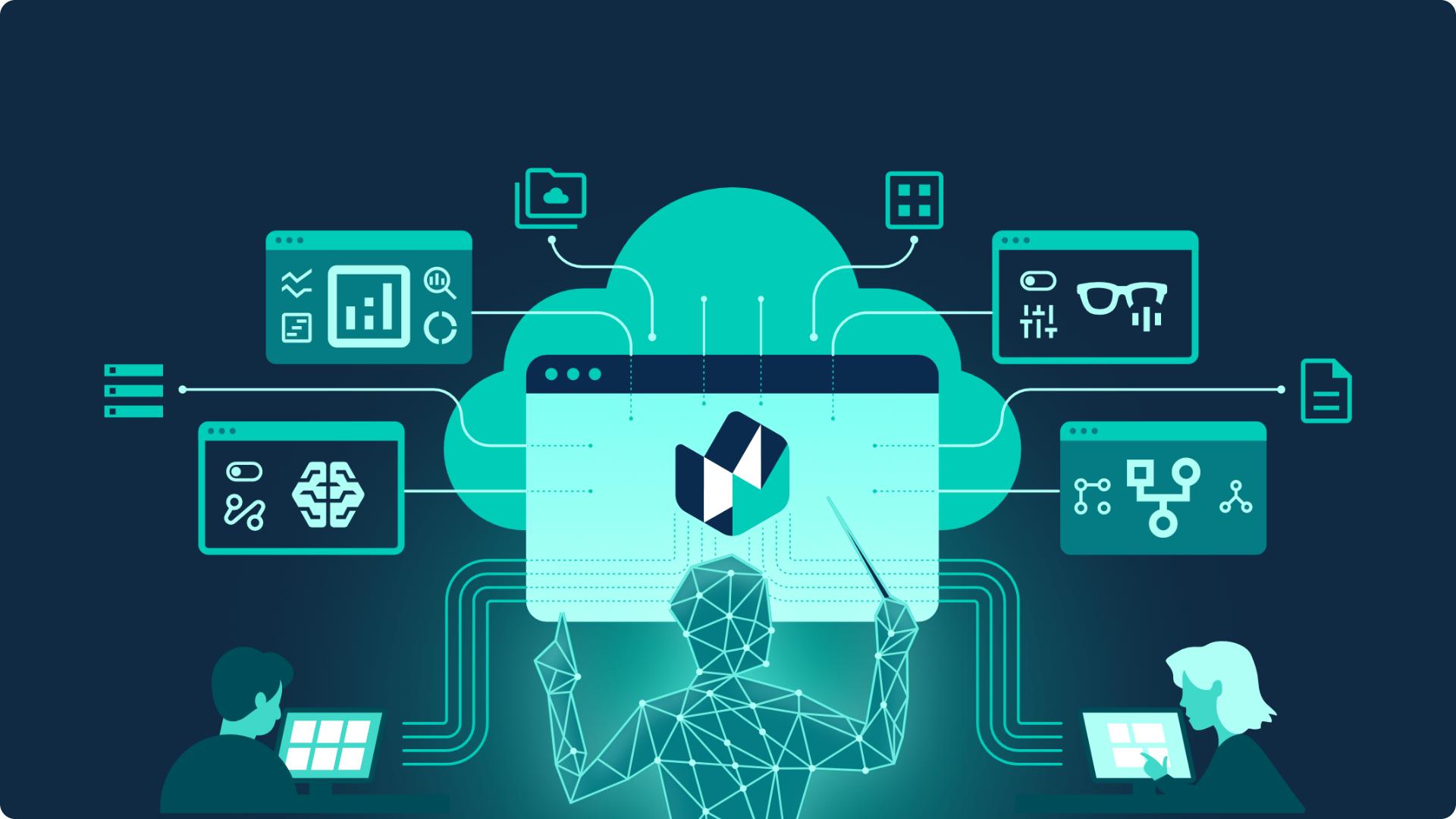
This is the core philosophy behind the Digital Experience Orchestration Platform (DXOP). And it requires a crucial distinction: myMeta does not build foundational AI models. We do not compete with the LLMs. Instead, we provide the Agentic OS, the orchestration layer that harmonizes them.
A DXOP operates as an "Authenticated Enterprise Bridge." It is an intelligent, non-intrusive overlay that sits on top of your entire application landscape. It connects the disparate AI agents working inside SAP, Salesforce, Workday, Coupa and more, and brings their collective intelligence directly to the user in a single, unified, fit-for-purpose experience.
AI stops being a destination you have to chase, and becomes a capability delivered exactly where and when you need it.
Marketing as the Human Orchestration Layer
To understand why this matters so profoundly at the operational level, consider the marketing function not just as a technology user, but as a structural phenomenon within the enterprise.
Marketing is, by its very nature, the most cross-functional department in any organization. To bring a single campaign to life, a marketing team must secure budget approval from Finance, align on headcount or agency resourcing with HR, extract product and pricing data from the ERP, obtain customer intelligence from Sales, and clear legal and contractual requirements through Procurement.
Marketing does not operate within a single domain. It operates at the intersection of all of them.
This means that the most experienced marketers have, over the course of their careers, developed a sophisticated and largely invisible skill: human orchestration. They have learned how to build trust with a Finance partner to accelerate budget approvals. They have cultivated relationships with Sales leaders to gain access to CRM insights. They have developed the language to translate a creative brief into a procurement-compliant scope of work. They are, in effect, the human "integration layer" of the enterprise bridging siloed departments, translating between their vocabularies, and ensuring that the right information reaches the right person at the right moment.
Here is the insight worth sitting with: the way a marketer manages cross-departmental relationships is structurally identical to what a DXOP does at the system level. When the human orchestration layer is strong - when relationships are trusted, communication is fluid, and context travels freely - campaigns move faster, decisions are better, and the organization performs at a higher level. When the system orchestration layer is strong, data moves with the same fluency. The two are mirrors of each other, operating at different altitudes but solving the same fundamental problem: how to make fragmented, siloed entities work as one.
The implication for marketing leaders is direct. Every hour your team spends manually exporting data from Salesforce into your marketing automation platform, or chasing a Finance partner for a budget figure that should be visible in context, or waiting for an HR approval to onboard a new agency partner, that is human orchestration filling the gap left by absent system orchestration. You are compensating, with relationships and effort, for the friction that technology has failed to remove.
A DXOP does not replace those relationships. It honors them by removing the administrative burden that obscures them. When customer data from Salesforce surfaces automatically within the marketing workflow, when budget visibility from Finance appears in context, when the AI agents across your stack are coordinated into a single guided journey, your team is freed to invest their relational capital where it actually creates value: in the strategy, the creativity, and the human judgment that no system will ever replicate.
The Competitive Imperative
The organizations that master AI orchestration in 2026 will establish a structural competitive advantage that will be difficult to replicate. BCG's research on AI-native firms finds that they are already achieving 25 to 35 times more revenue per employee compared to traditional peers (source: BCG, December 2025). Gartner predicts that by 2028, 90% of B2B buying will be AI agent intermediated, pushing over $15 trillion of B2B spend through AI agent exchanges (source: Gartner, November 2025).
The IDC FutureScape 2026 is unambiguous: "AI pilots are not enough. Enterprise orchestration unlocks scalable value in the agentic AI economy" (source: IDC, April 2026). The transition from isolated AI experiments to coordinated, enterprise-wide execution is the defining strategic challenge of the next three years.
We must stop forcing our team members to chase fragmented AI destinations and start orchestrating simplicity.
Ready to move beyond siloed AI and achieve enterprise-wide orchestration?
Download The 2026 Enterprise Experience Orchestration Playbook →
A strategic guide for CIOs, CHROs, COOs, and digital transformation executives, grounded in research from McKinsey, Gartner, BCG, Forrester, IDC, Deloitte, and Everest Group. Includes a typical implementation roadmap and a full business case framework for experience orchestration.
myMeta is the creator of the Digital Experience Orchestration Platform category. With 80+ enterprise clients and over 500,000 weekly users, myMeta orchestrates complexity and delivers simplicity across the world's most demanding application landscapes. Learn more at mymetasoftware.com.

.webp)